SYNOPSICS
Kosmos (2009) is a Turkish movie. Reha Erdem has directed this movie. Sermet Yesil,Türkü Turan,Serkan Keskin,Hakan Altuntas are the starring of this movie. It was released in 2009. Kosmos (2009) is considered one of the best Drama,Fantasy movie in India and around the world.
A strange man with otherworldly talents becomes both a friend and a pariah in a small Turkish town in this drama from writer and director Reha Erdem. Yahya is nearly in a panic when his young son falls into the river on a wintry day and looks lifeless when he's pulled from the water. But a stranger appears out of nowhere and takes the boy in his arms, and suddenly the child is breathing and perfectly healthy again. Yahya and his teenage daughter Neptun are grateful to the stranger, who they discover is named Kosmos, and they bring him into town, where they offer to find him a place to stay. But Kosmos, who often prefers to communicate in inarticulate noises, doesn't care for his new accommodations, and he develops a bad reputation for his habit of stealing things, his strange diet (consisting entirely of sweets), and his desire to bed as many women as possible, including Neptun. Kosmos is on the verge of being driven from the village when it's discovered that he can heal himself at ...
More




Kosmos (2009) Reviews
Summary contained in critical text.
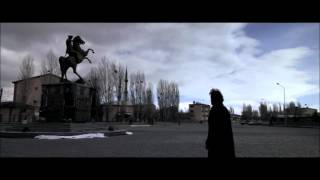
Contains spoilers. Reha Erdem's Kosmos is a rare film that exhilarates the spirit. Unclassifiable, it's best placed in one of those niches set aside for oddball jewels. Not a perfectly cut diamond – it digresses here and there and could be slightly trimmed – but a highly polished one nevertheless. Its hero Battal, who calls himself Kosmos, is brilliantly brought to life by Sermet Yesil. Yesil crafts him into one of the strangest and most endearing characters to emerge out of recent cinematic history. Quirky and intense, with a sub-layer of sadness that seems to reflect the suffering of the world. The film begins with his dramatic entry into the Turkish city of Kars, in eastern Anatolia, near the Armenian border. Erdem takes his time with the opening scenes: gripping and feverish, against a palette of sounds and snowscapes, they set the film's tone and prefigure its ending. Battal is a distant figure engulfed by a wintry landscape, running fearfully from unseen pursuers as he downs a snow-covered hill towards the river that runs through the city. He hears a young woman calling for help as she runs along the bank after the body of her brother, floating downstream in rushing water. After hiding a wad of bills (stolen?) under a rock, Battal pulls the child out of the water. In a wild frenzy of hugs, cries and rolling about, her brother is resuscitated. The beautiful young woman (Türkü Turan), who claims the boy was dead, finds instant affinity with Battal, and decides to call herself Neptune. Battal is then received as a hero by the locals and the neighborhood café owner offers him room and board for the menial job of clearing tables. The film recounts the events that occur as he shirks the job, steals money (which he mostly gives away) and roams the city, trying to alleviate the suffering of his fellows. It is soon clear that this stranger is a man of uncanny powers and otherworldly connections. Drawing his febrile energy from no more than sugar lumps and tea, he shimmies up trees like a feline and emits birdsong as he leaps, swings or flies (we never really see) from branch to branch. In one shrilling, virtuoso scene with Neptune, we get a flashing glimpse of his (their?) feet turned into those of a bird and of Battal walking upside down across a ceiling. His presence deregulates clocks, he claims to have been to Alpha Centauri and he has the power to heal, though not infallibly. A child he cures of muteness falls ill and dies, and the brittle school teacher he beds and cures of migraines jumps to her death. The film only drops hints as to why some healings fail and Battal seems as perplexed as we are. Battal's Kosmos never preaches, but gladly spouts his obtuse philosophy, spiked with homespun homilies, when questioned. He lauds the virtues of eschewing work and the delights of uniting soul and body in erotic love. When this boils down to spending a night of love with Neptune, her father stubs a cigarette out on his hand, but no matter, the burns vanish overnight. Other things are happening. There are huge and disturbing close-ups of cattle destined for slaughter. Mundane activities such as bringing in the geese are charged with ominous foreboding. But foreboding of what? A satellite that falls from space seems connected to Battal, but how? The film continually suggests that events are taking place at other levels, with deeper significances than meet the eye, but what are they? All of this is helped along by the film's exceptionally effective sound design and soundtrack, used as powerful mood enhancers, generating tension as the pace accelerates, giving rise to expectations of impending disaster, but does it ever come? Mysteries and loose ends abound at the end, most of all the identity of the elusive Battal. But the film's tight structure, centering on Battal and the Kars neighborhood, easily keeps the film from overloading As in Lynch, Kosmos is best experienced through emotional connections and recognitions than through reasoning. But while Lynch peels off layers of psyche to reveal our beasts within, Erdem quite happily relegates everything to the macrocosm. At the film's end, he whirls us upwards on an exhilarating ride deep into the real cosmos, where sheer awe tends to make any need for explanation seem paltry. In this film's magical way, everything comes harmoniously together in this joy ride to the stars, music crescendoing to the point of explosion. Altruistic thief, loopy star man, hybrid human – let's just say that Battal is blessed with unearthly powers that invite us to revel in the strangeness of the world. The film also invites reflection on marginality, tolerance and the meaning of freedom. For Battal is the bothersome man in the timeless tale of the other, the intruding visitor who rattles the social and moral order, pointing at their contradictions and hypocrisy. The status quo will never accommodate him, and he hightails it out of Kars just as he came in – this time running up the snowy hill, a tiny dot lost in the wintry landscape, with the police hot on his trail for thieving and basic "undesirability". A neat subtext emerges when a right-wing activist makes the rounds, drumming up support to oppose proposed measures to open the border with Armenia, in an effort to stimulate trade. Suspicious, he questions Battal about the nature of his visit. Battal replies only that he is an "unexpected guest". Disarmed, the hunky xenophobe can only utter back "welcome". That's what we should say too after seeing this exuberant film, teetering on the brink of a minor masterpiece.
Poetry and Divinty in Kars
I've never seen like this film before. Really. I think, Kosmos is a first scream about Turkish modern rebellion. You think like that it is politically, but not. Kosmos bound up with poetry revolt, post-modern disobedience, divinity individualism, valueless of values. In a nutshell, Kosmos is a literary uprising. Battal, Kosmos, is an outlander and take refuge in a small town where is in Kars, a forgotten city in Turkey. Kars' people want to be remembered and due to this reason they wish the borders must open. Because the small town is too far from both country and city. They feel like derelict and therefore they choke in daily routines, especially a female teacher, feeling be assigned by force to her job, a butcher, being thought of slaying animals, and his daughter. Everybody think that Kosmos is an answer their problems and he have a extraordinary power, being thought of curing their illness. In reality, all of them wants a clue about their existence but Kosmos doesn't. He does not interested in their pursuits and does not realize he is an answer. He seeks for love and his own god like Spinoza. I appreciate Reha Erdem as he made a movie discussing very philosophical and mentally confusing arguments. If you have a chance to watch this movie, you must enjoy listening Sigur Rosian musics ( A Silver Mount Zion and Rachel's) and disturbing movie effects.
Kosmos and Neptün
This review was written following a screening at Cambridge Film Festival (UK) - 15 to 25 September 2011 * Contains spoilers * Kosmos is what he calls himself, when he is asked his name. He has previously saved the young woman's brother, and he is delighted to hear her baying at him like a wolf, inviting him to follow her, to chase her. When he says that he is Kosmos, she says that she is Neptün, and I find myself thinking more of the seas, than of the planet. (Meeting the girl's father, he gives a different name, but he is credited as Kosmos (Sermet Yesil), and she as Neptün (Türkü Turan.) What we see is his visit to this indeterminate Muslim town in the snow, from when he arrives to when he leaves. All that we really know, as a foreign audience, is that he strays into areas where he should not be, that there are sounds of explosions, and that there is a border closed, which some would like opened, but which others say is just for their profit. If we are trying to judge him, to see whether the words that he speaks when asked questions and which have a ring of teaching such as from the Koran or the book of Ecclesiastes, then we will find that he does things to disapprove of. (But don't we all. He does not claim to be a great holy man, but answers people's questions, and seems to seek to help.) Ultimately, it is the disapproval, and the reliance that others have put upon him to cure as if it is without cost to himself (when we see at the start how he gives of himself to give life back to the boy whom he has rescued from the river), which cut short his time there. Some see him for who he is, but even the teacher, who sleeps with him, seeks to put her guilt on him – what he is looking for, he says, is love. With Neptün, whether or not they sleep together, there is an unbridled energy and exuberance, a dance as of elemental forces such as their names suggest. Even his acts of healing, and what happens with natural phenomena (reminiscent of what Tarkovksy does in Mirror), suggest that he has a connection that others have forgotten about or overlooked, and which the girl sees in him more fully. The woman who places reliance in the medication Tralin ® , an anti-depressant, seems at the opposite extreme, but he is nonetheless distressed for her. The crash-landing of some sort of lunar module, which the authorities want hushed up, but which he has already seen, seem to herald a time when judgement turns against him, and he has to leave, although not without showing his care for those who are hurting. He leaves as he arrived, and, except when he is with Neptün, there is always an ambiguous quality about his anguish and about his joy, as if their being two sides of the same coin is very close to him. This is a remarkable piece of cinema, and would invite me to see it again. What I would have to be clear about is not to do so to find out more about who Kosmos is, since we know only the time when he is with the people in this town and often have to guess at his motives or motivations, but to see how he is valued, to see what people see in him.
Oh Sinnerman, where you gonna run to?
Reha Erdem's Kosmos is a barren land, a desolate white town inhabited by ghosts, ghosts that are as real as you and I. In this cosmos, chance encounters have the power to throw things in and out of their orbit, and miracles are just as imminent as death. Through the masterful camera-work we follow the main character Kosmos (remarkable performance by Sermet Yesil) as he wanders through the snow-laden wilderness in eastern Turkey. His presence has a prominent role in the villagers lives, lives that are so wrapped up by borders and boundaries, real and imaginary, that never have come to grasp their true selves. The strength of the film largely benefits from the expressive performances from all of the cast. Thank you Reha Erdem and everyone involved with this spellbinding film for restoring my faith in Turkish cinema.
Way overrated by Turkish viewers
Just because you are shooting good visuals doesn't mean you have a fancy movie. Since Autumn by Ozcan Alper we know that good scenery can be presented well within a context, a plot and other essentials. So the good scenery here is in no way an excuse for such a dragging agony. Some of the comments here are really making me ask myself did I watch the same movie or what? What rebellion, what post-modern disobedience? Sermet Yesil was so overplaying, at times I was too embarrassed to be even watching him. You don't even need to check his name in Google to know he was picked up from a theater stage. His exaggerated cries, faces, unnaturally long and calm nonsense speeches. Who buys that? Who writes that? And in the end revealing the great mystery, the source of his superpowers was that thing in the sky which eventually burned up and crashed into the ground. What is that an oriental Truman Show? Allah was mad at him for abusing his powers so he smoked him up. For crying out loud move along people. If there is anything interesting about Kars's religiously mystical ways then rest assured Orhan Pamuk milked it dry long ago in his book Kar.